
Google DeepMind releases WeatherNext 3 today. It is the new leader on Operational WeatherBench (OWB), Brightband’s real-time comparison of the best AI and physics-based global medium-term weather forecast models.
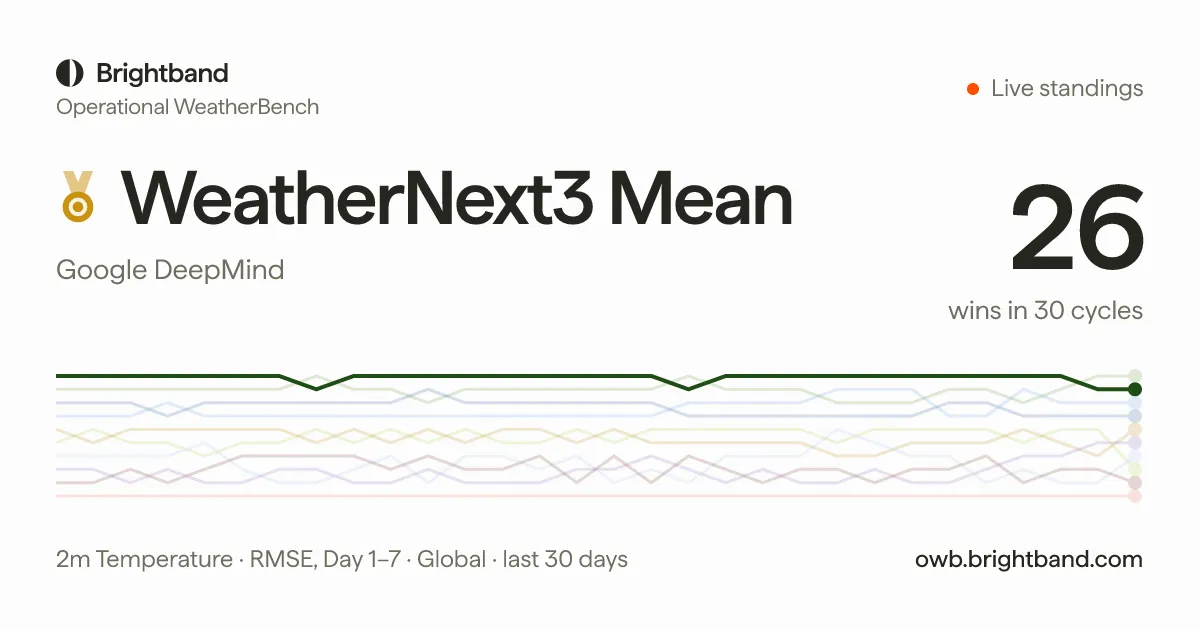
During August, the WeatherNext 3 ensemble forecast was regularly the most skillful out of all its peers, edging out its predecessor, WeatherNext 2. For 2-meter temperature – what people feel anytime they walk outside – WeatherNext 3 had the lowest error for 26 of the last 30 days.
One of the surprising results with WeatherNext 3 is how well it performs against higher-resolution surface analysis. Its 10 km gridded surface forecasts demands comparison with similarly fine-grain analysis, and it does better on this tougher comp than other models do against coarser resolution analyses. It also has some intriguing flexibility in what it can output.
When Brightband first launched the Operational WeatherBench dashboard last month, Google DeepMind’s WeatherNext 2 was the world’s best medium-range weather forecasting model, narrowly but consistently edging out the European Center for Medium-Range Weather Forecasting’s AIFS-ENS. It’s noticeable that the contemporary generation of AI weather models reliably out-perform their physics-based predecessors on OWBs headline metrics. Generally, four of the top five models are AI-based rather than physics-based.
One novel feature of WeatherNext 3 is the ability to ingest geostationary satellite data to help refresh the model every hour instead of every six hours. This highlights an important, growing trend of incorporating direct weather observations – from traditional weather stations, balloons, satellites, and more – into AI weather models. Brightband has championed this and pioneered the use of AI in “data assimilation”; Brightband regularly assimilates public and commercial weather observations with AI to generate forecasts. WeatherNext 3 highlights one of the creative ways in which observations can combine with these models to produce unique, skillful forecasts, and we’re excited to continue pushing on this frontier in our own research and operations.
See for yourself how WeatherNext 3 compares to the competition in our Operational WeatherBench. We’ll be expanding the evaluations we publish over the coming months, including comparisons against different types of observations as well as including additional AI weather models from NOAA and other organizations. If you’re interested in contributing a forecast to the project, please reach out to us at hello@brightband.com!